

Why does Brahms’s Second Symphony feel so warm?
Brahms’s Second Symphony begins quietly, with three notes in the low strings and winds. From that modest opening grows a work filled with song, changing light and some of Brahms’s most generous orchestral writing. It is often described as his “pastoral” symphony, but its warmth is not uncomplicated. Darker colors repeatedly pass beneath the surface, making the eventual sunlight more convincing.
The music preceding the symphony travels through several different Romantic worlds. Schubert’s Overture in the Italian Style opens with elegance, wit and theatrical energy. Weber’s Der Freischütz Overture leads us into a shadowed forest shaped by danger, fate and the supernatural. Mendelssohn’s Violin Concerto then places one impassioned individual voice at the center of the orchestra, with Katherine Anderson as soloist.
Together, the four works move between brightness and darkness, intimacy and drama. Brahms does not simply dispel the shadows heard earlier in the program. He absorbs them into a larger musical journey—one whose warmth feels earned.

Franz Schubert: Overture in the Italian Style in C major
Schubert wrote this overture during a period when the operas of Rossini were captivating Vienna. The music shares their brightness and theatrical flair, but its lyrical warmth remains unmistakably Schubert’s.
A poised introduction soon gives way to music that seems ready for the curtain to rise. Melodies pass quickly through the orchestra, crescendos gather momentum and rhythmic surprises keep the music moving toward an exuberant conclusion.
Listen for:
-
The contrast between the graceful introduction and the faster music that follows
-
The characteristic crescendos that continually increase the excitement
-
Woodwind melodies that give the overture its playful, theatrical character
Duration: 7'

Carl Maria von Weber: Der Freischütz Overture, Op. 77
A forest, a shooting contest and a bargain with dark forces lie behind Weber’s Der Freischütz. The opera became one of the defining works of German Romanticism, combining the natural world, folklore and the supernatural.
The overture contains that entire dramatic world in miniature. Four horns evoke the forest and the life of the hunter. Low strings and clarinets lead us into something more ominous, while urgent orchestral outbursts suggest the danger closing around the story’s central characters. A broad, radiant melody eventually points toward redemption—but Weber makes us pass through the shadows before allowing us into the light.
Listen for:
-
The opening horn calls and the world of the forest they establish
-
Low clarinets and strings darkening the atmosphere
-
Sudden contrasts between supernatural tension and lyrical hope
-
The return of the radiant closing theme in the full orchestra
Duration: 10'

Felix Mendelssohn: Violin Concerto in E minor
First movement: Allegro molto appassionato
The violin does not wait through a long orchestral introduction. Almost immediately, it enters with an urgent, restless melody—as though the music has already begun before we are permitted to hear it.
That entrance sets the character of the first movement. The soloist is continually moving between impassioned lyricism and dazzling technical demands, but the virtuosity always serves the musical argument. Mendelssohn also connects the movement’s sections without the customary pauses, creating a sense of uninterrupted momentum.
Listen for:
-
The solo violin’s immediate entrance over quietly agitated strings
-
The contrast between the restless opening and the more tender second melody
-
The cadenza—an extended passage for the violin alone—placed before the principal themes return
-
The soloist’s final rush toward the movement’s conclusion
Duration: 10'
Intermission
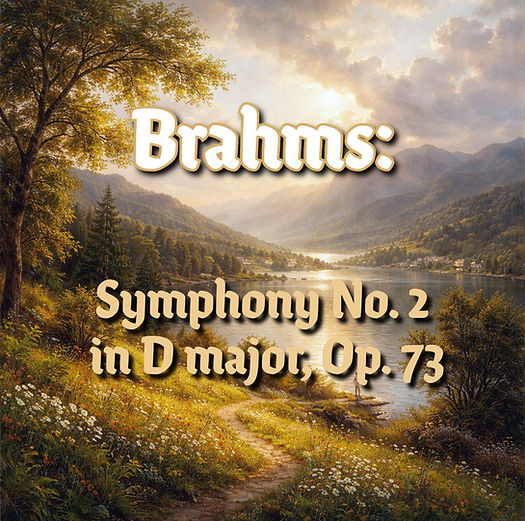
Johannes Brahms: Symphony No. 2 in D major, Op. 73
Brahms composed his Second Symphony during the summer of 1877 in the lakeside village of Pörtschach, surrounded by mountains, woods and water. The symphony’s flowing melodies and luminous orchestral colors have often encouraged listeners to hear it as his musical response to that landscape.
But this is not an uncomplicated pastoral idyll. The opening melody grows from three quiet notes in the low strings and winds. Almost immediately, timpani, trombones and tuba introduce a darker undertone. Throughout the symphony, warmth and unease remain close companions.
The second movement deepens that tension, beginning with an expansive cello melody before moving through moments of repose and turmoil. The third offers a graceful oboe theme interrupted by two quick, animated transformations. In the finale, restrained energy gradually breaks free, carrying the full orchestra toward a brilliant conclusion.
The symphony feels warm not because darkness is absent, but because Brahms allows light and shadow to coexist. Its final joy is powerful precisely because we have heard what lies beneath it.
Listen for:
-
The three-note idea in the low strings and winds that helps generate the opening movement
-
The trombones, tuba and timpani quietly disturbing the pastoral atmosphere
-
The long cello melody at the beginning of the second movement
-
The oboe’s graceful theme—and its faster transformations—in the third
-
The finale’s restrained beginning and steadily accumulating energy
-
The blazing brass at the symphony’s conclusion


